Filipinas Dentro de Cien Años: Rizal's Predictions for the Philippines' Future
In Filipinas Dentro de Cien Años, José Rizal predicted the eventual end of Spanish rule in the Philippines if reforms weren't made, while cautioning that independence alone wouldn't solve the nation's problems without proper preparation. Published in La Solidaridad between 1889 and 1890, the essay remains notable for its striking foresight, years before the 1896 Revolution and 1898 Spanish-American War. Explore José Rizal's essay Filipinas Dentro de Cien Años, where he predicted the eventual end of Spanish colonial rule and warned of the challenges the Philippines would face afterward — a call for reform grounded in sober political analysis rather than pure prophecy.
 Moderator - Tomas Kauer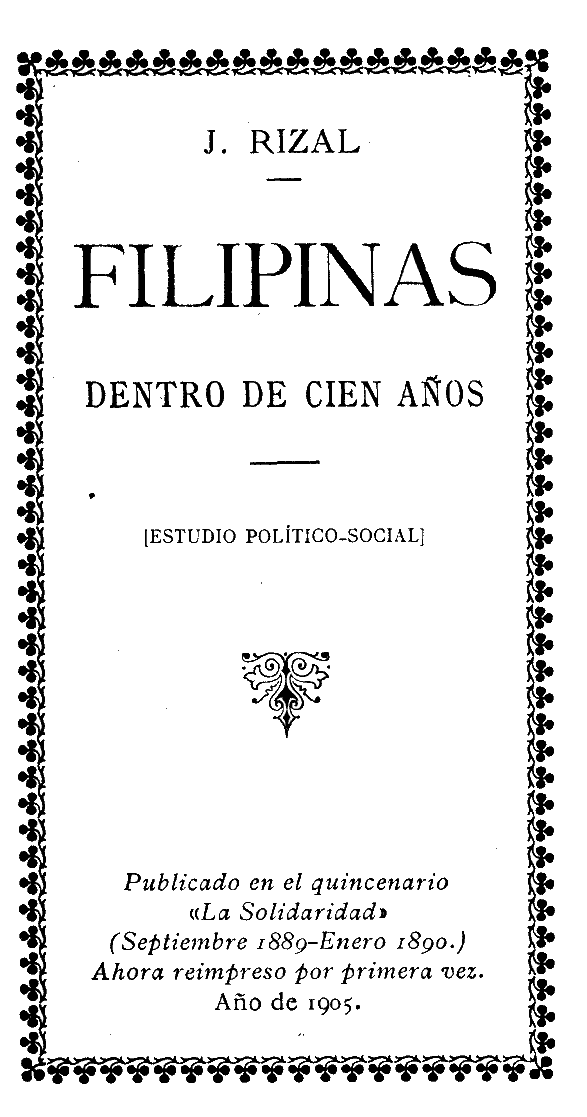
It's one thing to criticize the present. It's another thing entirely to look ahead and try to predict what comes next. In Filipinas Dentro de Cien Años ("The Philippines a Century Hence"), José Rizal did exactly that — stepping back from the immediate grievances of colonial rule to ask a harder, more strategic question: what would actually happen to the Philippines if things continued as they were, and what needed to change to avoid the worst possible outcomes?
Background and Publication
The essay was published in installments in La Solidaridad between 1889 and 1890, the same reformist newspaper where much of Rizal's political writing appeared during his years in Europe. Unlike his novels, which used fictional characters and narrative to expose colonial abuses, this essay was a direct, analytical piece — Rizal writing plainly as a political thinker rather than a novelist, laying out his reasoning about the Philippines' likely future under continued Spanish rule.
Rizal's Central Argument
At the heart of the essay is a sobering warning: Spanish colonial rule, if left unreformed, was on an unsustainable path. Rizal argued that the accumulated weight of economic exploitation, lack of political representation, and systemic neglect of Filipino welfare would eventually reach a breaking point — one way or another.
Rizal didn't frame this as a call for immediate revolution. Instead, he presented it almost as a warning to the Spanish government itself: reform now, extend genuine rights and representation to Filipinos, or risk losing the colony entirely through unrest, rebellion, or intervention by another foreign power.
Predicting the End of Spanish Rule
Perhaps the most historically striking aspect of the essay is how directly Rizal predicted that Spanish rule over the Philippines would eventually come to an end. Writing years before the Philippine Revolution of 1896 and the Spanish-American War of 1898, Rizal argued that continued mismanagement and neglect made the eventual loss of the colony almost inevitable — a prediction that would prove remarkably accurate within less than a decade of the essay's publication.
He was careful, however, not to frame this outcome as something to be celebrated without caution. Rizal expressed genuine concern about what might follow the end of Spanish rule, worrying that the Philippines could remain vulnerable to exploitation by whichever power stepped into the resulting vacuum, unless Filipinos themselves were adequately prepared — educationally, politically, and civically — to govern their own affairs.
Weighing Possible Futures
Rizal explored several possible scenarios for the Philippines' future in the essay, reflecting his effort to think through the political landscape realistically rather than simply hope for the best outcome. These included continued Spanish rule under reformed, more equitable conditions; the possibility of the Philippines being ceded to or contested by another colonial power; and the prospect of eventual Filipino self-governance, whether achieved gradually or through more abrupt upheaval.
Notably, Rizal did not treat independence as an automatic solution to all of the Philippines' problems. His central concern remained consistent throughout much of his writing: that any political transition, however it occurred, needed to be met with a population educated and prepared enough to build a just, stable, and self-sufficient nation — otherwise, one form of exploitation might simply be replaced by another.
A Call for Reform, Not Just a Prophecy
While the essay is often remembered for its striking predictive accuracy, its underlying purpose was fundamentally about advocacy, not prophecy. Rizal wasn't simply forecasting the future for its own sake — he was making a strategic argument aimed at Spanish authorities and reform-minded readers alike: that meaningful reform was not just a matter of justice, but a matter of practical necessity if Spain hoped to retain a stable, loyal colony rather than lose it entirely.
This framing reflects Rizal's broader approach throughout his life — even when confronting difficult truths about colonial rule, he consistently searched for a path toward peaceful resolution before revolution, appealing to reason and mutual interest rather than simply predicting inevitable conflict.
Why the Essay Still Resonates
Filipinas Dentro de Cien Años remains a compelling piece of political writing not just because of its historical accuracy, but because of the clarity and discipline of its reasoning. Rizal approached an emotionally charged topic — the future of his colonized homeland — with careful, structured analysis rather than pure sentiment, modeling the same kind of systemic thinking found in his other major essays, such as Sobre la Indolencia de los Filipinos.
More than a century later, the essay stands as a testament to Rizal's ability to think beyond his own moment in history — not simply reacting to injustice, but trying to anticipate its consequences, and urging those in power to choose a better path before circumstances forced a far more painful one.